

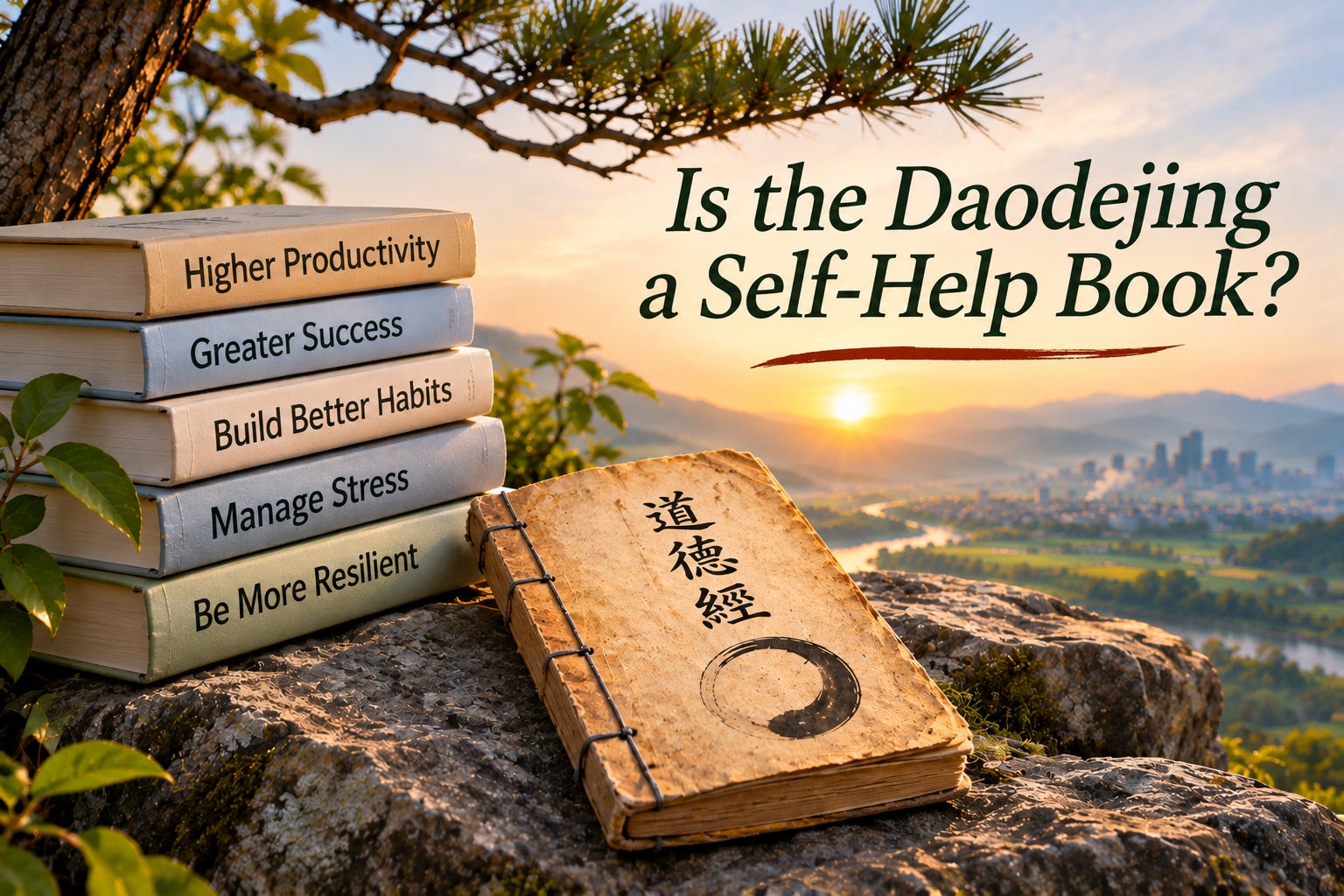
The Daodejing (Tao Te Ching) is often introduced as a book about inner peace and self-cultivation, learning to go with the flow, being spontaneous, and finding harmony in a chaotic world. Inspirational posters feature quotes like “A journey of a thousand miles begins with the first step,” or Bruce Lee’s famous “Be water, my friend.” Its teachings are frequently presented as timeless wisdom for reducing stress, letting go of attachments, and finding contentment in life. Critics, on the other hand, complain that the book advocates accepting everything and doing nothing. Based on many popular interpretations, I’m inclined to agree with the critics. But I think the popular view gets it wrong. Treating the Daodejing as an ancient Eastern self-help book actually undermines its central message.
Don’t get me wrong. I have nothing against learning how to live a better life. My concern with self-help books, and much of the personal development industry, is less about what they teach than what they leave unquestioned. They generally begin with the individual and ask what that person can do differently to become happier, healthier, more productive, or more successful. Develop better habits. Change your attitude. Set clearer goals. Become more resilient. Much of this can be genuinely helpful. But an assumption lurks beneath these approaches: that the world we are trying to succeed in is largely a given, and that the responsibility for adapting to it falls on us. What if the stress, insecurity, and competition we’re trying to overcome aren’t failures of the system, but consequences of how it was designed to work?
Consider what happens when the conditions of our lives contribute to our difficulties. If people are exhausted because of unreasonable work demands, teaching them stress management may help them cope, but it does nothing to address the demands. If people struggle financially because wages have failed to keep pace with the cost of living, teaching them to budget more carefully may be useful. Still, it does not resolve the underlying problem. If our social arrangements encourage competition, isolation, and insecurity, learning to become more resilient may help us endure those conditions without ever questioning why they exist.
In fact, there is a troubling possibility here. When we focus exclusively on helping individuals adapt to harmful conditions, we risk leaving the conditions themselves unchallenged. What appears to be personal growth can sometimes become training in tolerating conditions that undermine our wellbeing.
I understand the appeal. We didn’t choose the game, and most of us have little power to change its rules. We still have to make a living, care for our families, and navigate the world as it is. Learning how to play the game successfully is often a practical necessity. But there is a difference between learning how to succeed within a system and asking whether the system itself is worth preserving.
This is where I believe the Daodejing offers something radically different. Rather than simply teaching us how to play the game better, it invites us to question the game itself: the assumptions on which it was built, the behaviors it rewards, and the consequences those arrangements produce.
But this approach has a problem. If our difficulties arise from political, economic, and social systems largely beyond our control, doesn’t recognizing that leave us feeling even more powerless? At least self-help gives us something we can do. We may not be able to change the rules of the game, but we can learn to play it better.
I think this concern is legitimate. There is little value in helping people recognize the problems with the world around them if all we leave them with is a sense of helplessness. And I certainly don’t want to suggest that people abandon the practical steps that help them navigate their circumstances.
But perhaps we’re looking at the problem in the wrong way. We tend to think of ourselves as individuals confronting systems that exist independently of us. The systems shape our lives, and we either learn to navigate them or attempt to change them. Yet those systems are not separate from the people who participate in them. They exist through relationships, practices, expectations, and behaviors that are continually being reproduced and transformed.
We are shaped by the systems we inhabit, but we also help shape them.
This doesn’t mean that we can simply choose to change the world around us. Our influence is limited, and the consequences of our actions are never entirely within our control. But neither are we powerless observers. Every action takes place within a network of relationships and contributes, however modestly, to what happens next.
This is an important part of what I find in the Daodejing. It invites us to reconsider not only the systems we live within, but how we understand our relationship to them. Rather than imagining that we must either adapt to the world as it is or impose our vision of how it ought to be, we can start by observing how things actually work, learn to recognize the assumptions we have inherited, and discover ways to act differently.
Consider Chapter 75 of the Daodejing:
The people are hungry,
Because their superiors take too much food tax,
Therefore, they are hungry.The people are difficult to govern,
Because of their superiors’ actions,
Therefore, they are difficult to govern.The people take death lightly,
Because their superiors seek an abundant life,
Therefore, they take death lightly.Only those who do not make [their own] lives the object of their actions
Are superior to those who prize their own lives. (my translation)
Notice where the text directs our attention. Rather than blaming the people for their hunger, their resistance to authority, or even their disregard for death, it identifies their rulers' actions as the source of these problems.
The three observations describe a troubling progression. Rulers pursuing their own abundance impose burdens that leave people hungry. Their actions make the population increasingly difficult to govern. And when the pursuit of abundance by those in power makes life sufficiently intolerable for those below them, even the threat of death begins to lose its power.
The final lines turn the criticism back upon the rulers themselves. Those who make their own lives the object of their actions, seeking to secure and enrich themselves through their governance, undermine the very conditions that sustain life. The alternative is not to disregard life, but to stop treating one’s own prosperity as the purpose of governing.
This is a strikingly different approach to improving people’s lives. Instead of asking how individuals can better cope with hunger, hardship, or oppression, the Daodejing asks us to examine the arrangements that produce those conditions in the first place.
And perhaps that is the deeper lesson for self-help. Improving our lives is a worthwhile pursuit, but we cannot adequately understand our own wellbeing without considering how our actions affect others’ wellbeing.
The Daodejing does not promise that we can eliminate suffering or create a perfect society. Nor does it offer a blueprint for changing the world. It offers something more modest, but potentially more useful: a way of understanding the world, ourselves, and how everything is related, which can transform how we participate in the world.
The Daodejing cannot be understood merely as a self-help book because its concern with individual wellbeing is inseparable from the wellbeing of others and the world that sustains us.
Continue the Conversation
Ideas become more meaningful when we explore them together. If this article sparked a thought or raised a question, I’d love to hear your perspective in the comments. And if you found it worthwhile, please consider sharing it with others who might be interested.
If you’d like to take the conversation further, you’re warmly invited to join us at Kinship Cafe, where we explore these ideas together and consider what they mean for how we live and relate to one another.
I enjoyed this article very much. When you look at politics, it’s about the world we live in, our shared experience. People who say they are “not political“ miss something right in front of them. Our environment, our society, the interconnected world we live in, provides either a supportive world or a non-supportive world.
Good politics looks at the entire system, and works to make society more supportive of everyone, not just a chosen few. To tell people “just work harder“ in an unsupportive system, a rigged system, designed to keep the rich and powerful in a comfortable position, is oppressive and should be changed to one that benefits everyone.