

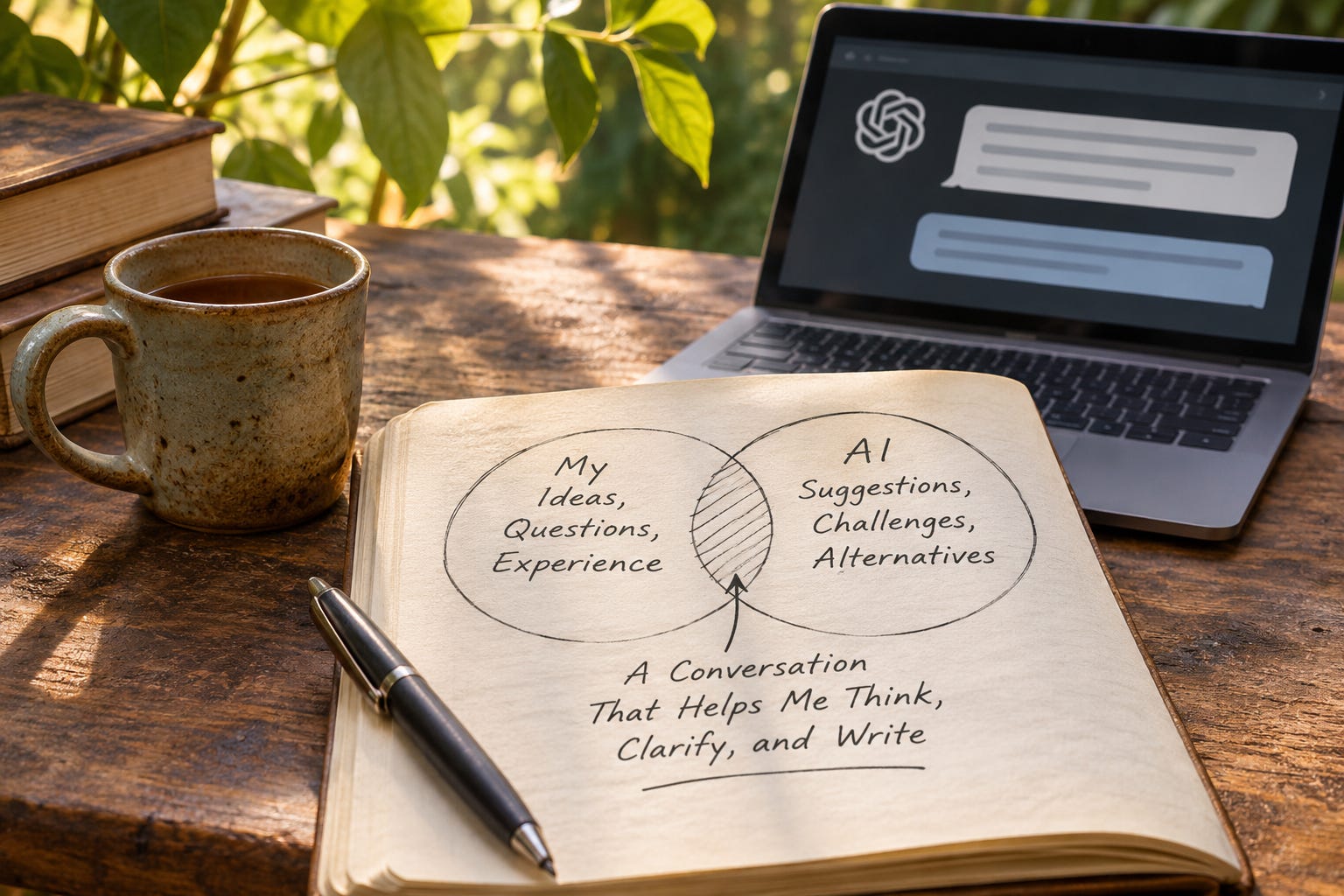
I use artificial intelligence (AI) in my writing, and I think it is important to be transparent about what that means.
My writing projects begin with questions, observations, and ideas that I have been exploring, often for years. I use AI as a conversation partner to develop those ideas, much as I might discuss them with a colleague willing to challenge my assumptions, point out weaknesses in my arguments, and suggest alternative ways of understanding something.
The process is rarely as simple as asking AI to write an article about a subject. More often, I begin with a rough draft or an idea I am trying to work through. We discuss it. AI offers suggestions, raises questions, and sometimes disagrees with my interpretation. I respond, clarify my position, reject suggestions, or reconsider my assumptions. This exchange may continue through several rounds before I am satisfied with the direction.
I also use AI as an editor. It helps me organize my thoughts, improve clarity, identify repetition, and find better ways to communicate complicated ideas. Sometimes I incorporate wording it suggests. Other times, I rewrite it entirely. The final text may therefore contain language developed with AI assistance, but the arguments and conclusions are ones I have considered and chosen to stand behind.
There are also important limitations. AI can be confidently wrong. It can agree too readily, overlook relevant evidence, or present questionable interpretations as facts. This is particularly important in my work with ancient Chinese texts, where translation choices and historical interpretations can be genuinely contested. I do not treat AI as an authority, and I remain responsible for evaluating the information and arguments I publish.
In some ways, this process reflects a conviction central to much of my writing: our understanding of the world develops through relationships. Thinking is not something that happens entirely in isolation. Conversations, books, experiences, disagreements, and now AI can all contribute to how we develop and refine our understanding.
AI helps me think through and communicate my ideas. It does not determine what I think.
Ultimately, I take responsibility for everything I publish, including any errors, omissions, or misunderstandings. I hope that readers will evaluate my writing based on the quality of its arguments and the questions it raises, rather than simply on whether AI played a role in producing it.